

Klaudia Biskup
Field Study: Emerging Typographic Particles
Void.
Nothingness.
The unknown.
Before form develops, a field of visual possibilities exists where fragments, lines, and patterns interact to organize into graphic forms. In this process, structure coalesces into visual signals through which meaning emerges.
In Field Study: Emerging Typographic Particles, letterforms exist as temporary states of linear elements that continuously interact and self-organize across the field. Only through interaction does the viewer perceive these states in forms that momentarily emerge as recognizable letters.
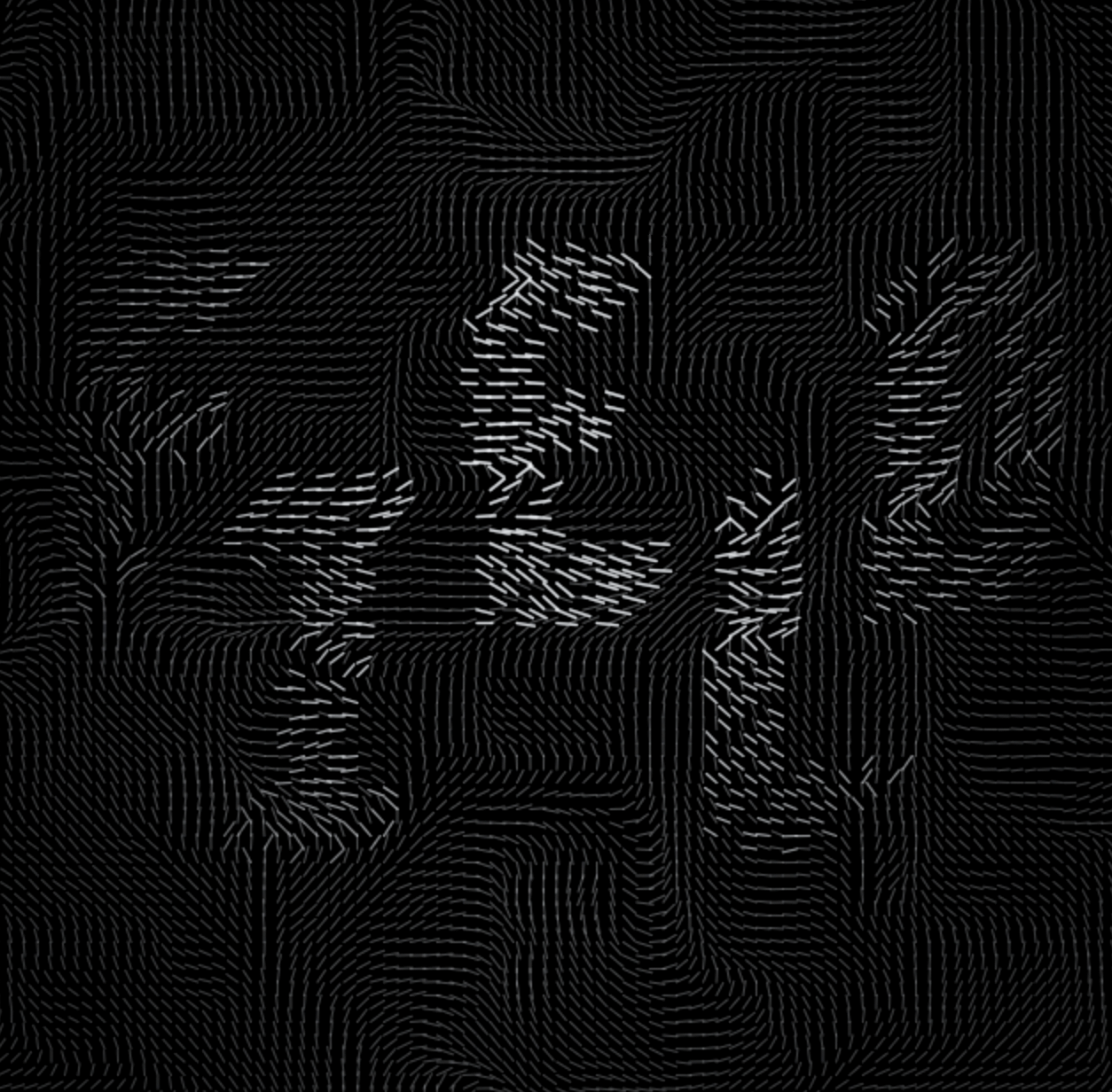
The project references quantum field theory, a framework from physics that describes an invisible field of energy and information that exists beyond space and time. In this field, particles such as electrons behave unpredictably — they are perceptible at one moment and then disappear the next, making it impossible to determine where or when they will appear. Only through observation does this field of probabilities resolve into a specific particle, a process known as wave function collapse. When the act of observation ends, the particle returns to a state of potential, dissolving back into the energetic field.
In this study, the line functions as the fundamental unit of the typographic system. Through repetition and variation, linear elements act as particles organized into letters.
In the digital version of the project, these elements are converted into code using p5.js, an open-source JavaScript library. The elements behave like particles within a generative system; they move, change, and shift in an unpredictable manner. The viewer’s physical movement acts as the active observation, collapsing the field of shifting particles into a letterform. When interaction ends, the form dissolves, returning to a state of potential within the field.
For this study, I designed two experimental typefaces, Process 1.0 and Process 1.1, that explore letterforms constructed from linear repetition and variation. The project is documented in a publication that presents Moiré patterns explorations, a type specimen, and a written statement. Through a sequence of pages, linear elements gradually stabilize into recognizable typographic forms. In this way, the publication presents a system in which forms emerge, stabilize, and dissolve over time.
The project is motivated by an interest in impermanence, instability, and the conditions under which meaning emerges. It considers typography not as a fixed form, but a transient state that appears only momentarily before dissolving back into a field of potential.
By examining the ways in which a field of linear particles resolves into observable letterforms, the study raises questions about how meaning is formed and communicated. Even in a condition of noise and variability, letterforms continue to function as visual signals that organize language into readable structures. In this context, how does meaning emerge when the signal itself is unstable or constantly shifting—or is it always in a state of becoming?